


Geomembrane Pond Volume Calculation
Geomembrane ponds are now widely used in various agricultural projects, aquaculture ponds, industrial water storage, and even environmental applications. One of the most important stages in designing and constructing these ponds is calculating the exact volume. Accurate volume calculation is essential not only for estimating construction costs and required materials but also for ensuring proper performance and safety. In this article, we review the practical methods and key tips for calculating the volume of geomembrane ponds.
1. Importance of Accurate Geomembrane Pond Volume Calculation
Calculating the volume of a geomembrane pond is important for several reasons:
- Estimating the required geomembrane liner: The more accurately the pond dimensions and volume are defined, the more precisely the amount of geomembrane needed to cover the base and walls can be calculated. This reduces material waste and overall project cost.
- Determining water or liquid storage capacity: In agricultural and aquaculture projects, accurate volume calculation helps to determine the actual water capacity and the amount of water needed for refilling.
- Engineering and system planning: The pond volume determines the size of pumps, pipes, valves, and other equipment. Incorrect calculation may lead to poor performance or system failure.
- Calculating the pressure applied to the geomembrane: The pond’s water volume directly correlates with water weight, which is crucial for mechanical design and determining the appropriate geomembrane thickness.
2. Types of Geomembrane Ponds and Their Geometry
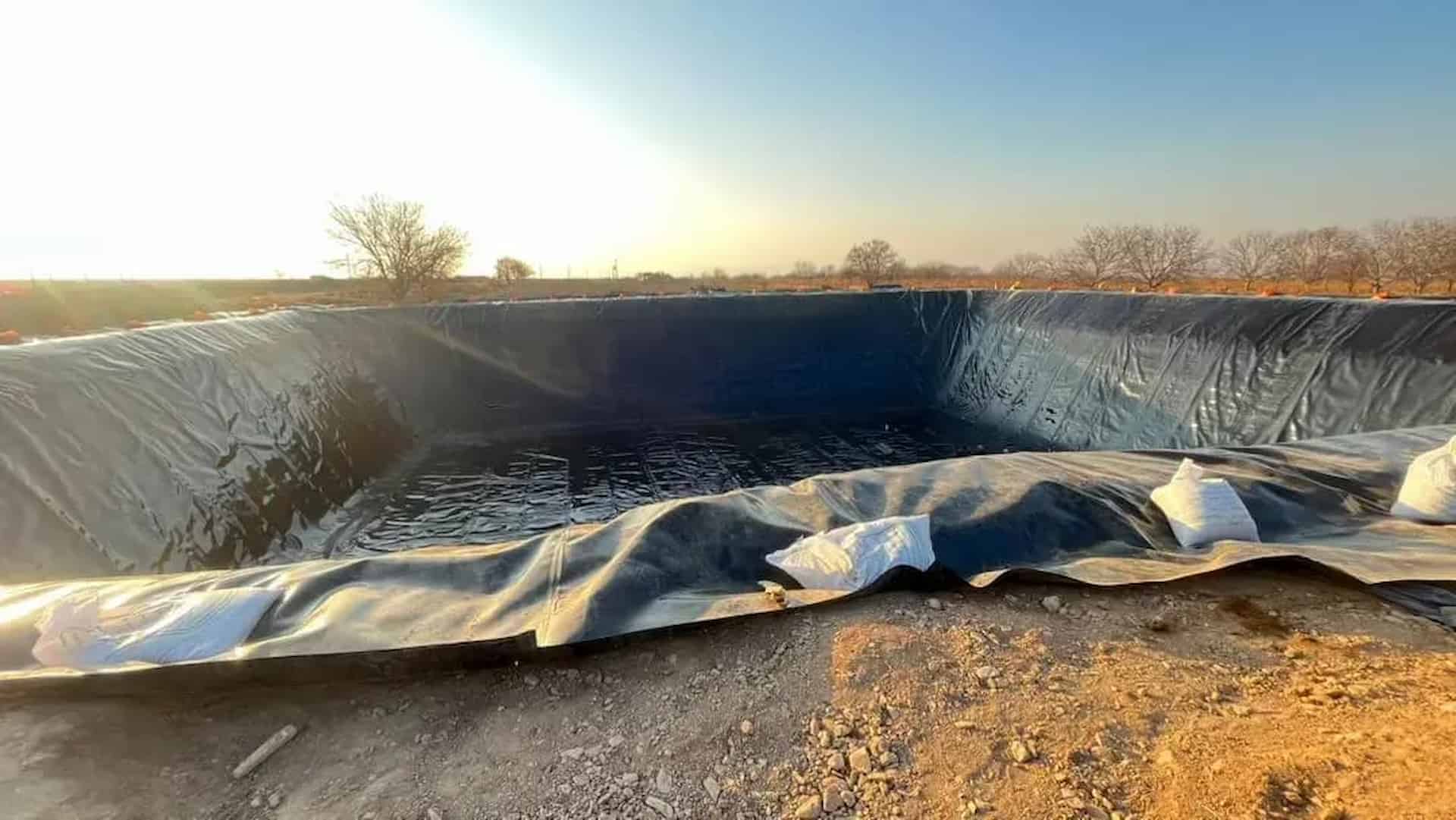
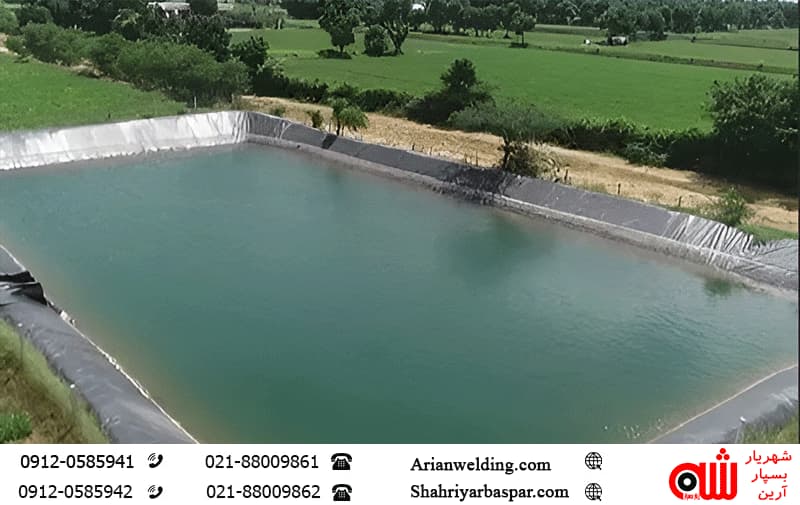
Before calculating the volume, the pond geometry must be identified. Geomembrane ponds are typically constructed in one of the following shapes:
- Rectangular ponds: The most common type for agriculture and aquaculture. They have a defined length (L), width (W), and depth (H).
- Circular or elliptical ponds: Often used in industrial projects or water storage tanks; the diameter or radius and depth determine the volume.
- Irregular ponds: When the terrain or site conditions dictate an irregular shape. In these cases, approximate methods or surveying software must be used.
3. Volume Calculation for Rectangular Ponds
Rectangular ponds are the easiest to calculate. The formula is:
V = L × W × H
Where:
V = Volume (m³)
L = Length (m)
W = Width (m)
H = Average depth (m)
Note: Use average depth when the pond bottom is sloped.
Example:
If L = 20 m, W = 10 m, and H = 3 m:
V = 20 × 10 × 3 = 600 m³
This means the pond can hold 600 cubic meters of water or other liquids.
4. Volume Calculation for Circular Ponds
For circular ponds, the volume is calculated using radius and depth:
V = π × R² × H
Where:
R = Radius (m)
H = Average depth (m)
Example:
For a pond with radius 5 meters and average depth 2 meters:
Pond Calculation — refer to the link below.
5. Volume Calculation for Irregular Ponds
In real-world projects, the pond shape may be irregular. Methods include:
Dividing the surface into simpler geometric shapes:
The pond is divided into rectangles or triangles, and the volume of each part is calculated separately.
Using 3D design and modeling software:
Software such as AutoCAD Civil 3D, ArcGIS, or hydraulic simulation tools can calculate the pond volume with high accuracy.
Cross-sectional averaging method:
By measuring surface areas at different elevations and averaging them, the approximate volume is calculated. This is useful for large and complex ponds.
6. Safety Factor and Losses
When calculating the pond volume, a safety factor must be added to account for evaporation, seepage, and potential losses. Typically, an additional 5–10% is included.
7. Importance of Selecting the Proper Geomembrane Thickness
After calculating the volume, the next step is choosing the right geomembrane. Thickness depends on hydrostatic pressure and environmental conditions:
- Small or shallow ponds: 0.5–0.7 mm geomembrane.
- Large or deep ponds: 1.0–2.0 mm thickness recommended.
- Industrial applications or harsh conditions: HDPE geomembrane with higher thickness.
Correct geomembrane selection increases pond lifespan and prevents leakage.
8. Calculating the Required Geomembrane Area
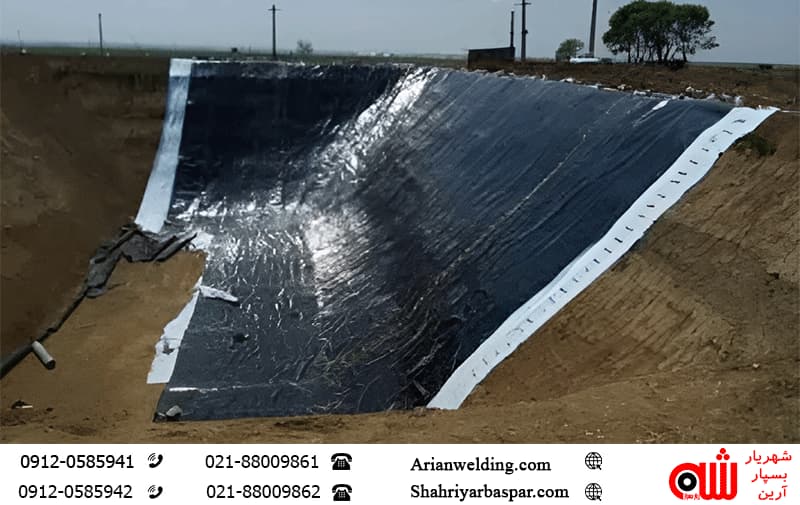
For full pond lining, both the base and walls must be calculated:
Sgeomembrane = Sbase + Swalls + extra for seams and edges
For rectangular ponds:
Sgeomembrane = (L × W) + 2 × H × (L + W) + 10% extra
This helps accurately estimate the required geomembrane and prevents shortages or waste.
9. Practical Tips for Pond Volume Calculation
- Accurate measurement: Measure the pond dimensions carefully before construction.
- Determine the operational depth: The actual water-holding depth is more important than maximum excavation depth.
- Account for bottom slope: Use average depth when the pond floor is sloped.
- Calculate pressure and water weight: Use water density to determine the load on the geomembrane and select proper thickness.
- Add safety margin: Include 5–10% extra volume for evaporation and losses.
Summary of Geomembrane Pond Volume Calculation
Calculating the volume of a geomembrane pond is a key step that affects cost, construction time, durability, and overall project performance. Using simple geometric formulas for rectangular and circular ponds, along with specialized software for irregular shapes, allows for highly accurate volume estimation. In addition, selecting the right geomembrane type and thickness and including a safety factor ensures long-term performance.
Shahryar Bespar Aryan Company, as the largest and first manufacturer of geomembrane welding machines and equipment in Iran, provides high-quality geomembrane liners as well as engineering consultation for accurate pond volume calculation and construction. With these services, projects can be executed faster, safer, and more economically.